

Global water assessments produced by the United Nations system, UN-Water, UNESCO, FAO, the World Bank, regional institutions, research networks, and national governments have played an essential role in alerting the world to drought, scarcity, groundwater depletion, pollution, rising demand, and climate risk. These reports are valuable because they help direct finance, policy reform, emergency planning, and long-term resilience strategies.
However, many existing frameworks understandably focus on the liability side of water systems I.e "Global Water Bankruptcy". They measure shortages, stress ratios, falling reserves, future demand gaps, and crisis exposure. These indicators are necessary, but they do not always show the full strategic picture.
A second side of the balance sheet deserves equal attention: water assets.
Water assets include rainfall over land, recharge opportunities, recoverable stormwater, treated wastewater reuse, storage systems, and the governance capacity to convert these resources into dependable annual supply.
This is where the Global Water Sovereignty Index (GWSI) is proposed as a complementary metric that expands current water crisis reporting from risk measurement toward solution measurement.
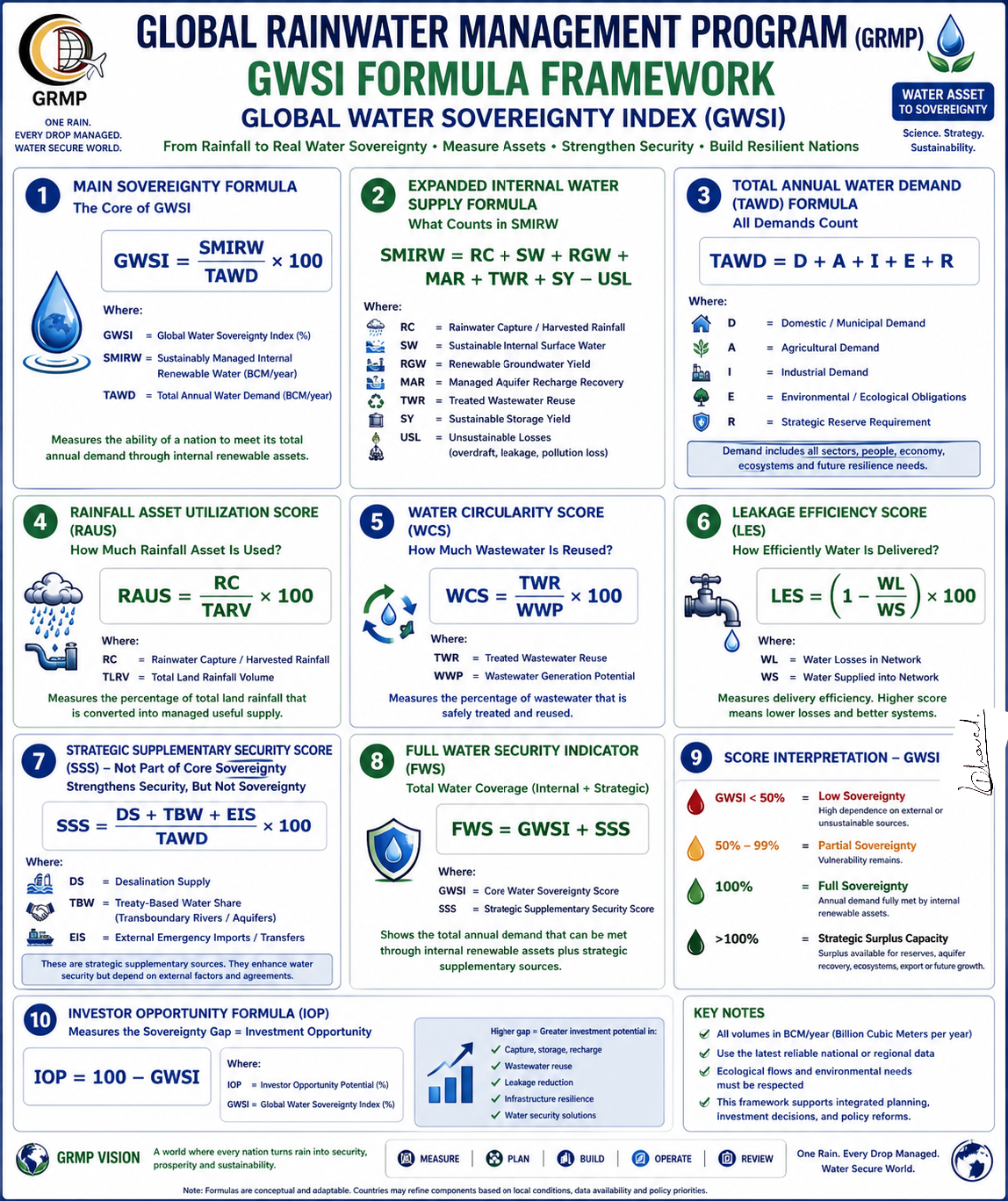
GWSI: The Global Water Sovereignty Index (GWSI) measures a nation’s ability to sustainably and reliably meet its total annual water demand through internally available, responsibly managed, and renewable water resources under its sovereign control. Strategic supplementary sources such as desalination, treaty-based transboundary river allocations, shared aquifer agreements, and external emergency supplies may strengthen water security, but are assessed separately from core water sovereignty.
Why GWSI Is Required
Many countries today face water contradictions that conventional metrics alone cannot fully explain.
Some nations experience severe floods and severe droughts within the same decade. Others report water shortages despite receiving meaningful annual rainfall. Groundwater declines continue in places where recharge potential exists. Cities often discharge stormwater to rivers or sea while investing heavily in expensive emergency supply systems. In many water-stressed regions, wastewater reuse remains far below its technical potential.
These realities suggest that water insecurity is not always caused only by lack of water. It is often also caused by:
- underused rainfall assets
- inadequate storage
- weak recharge systems
- low reuse rates
- leakage losses
- fragmented governance
- incomplete performance indicators
Traditional metrics ask:
How much water is lacking?
GWSI adds another equally important question:
How much available water is being converted into security?
That change in perspective is why GWSI is required.
Core Insight Behind the Index
A nation may receive large volumes of rainfall each year, yet still suffer restrictions, tanker dependence, aquifer depletion, or drought emergency measures.
If citizens remain water insecure despite recurring rainfall, the issue may not be rainfall volume alone. The issue may be weak systems for capture, storage, recharge, treatment, transfer, and efficient reuse.
Therefore, long-term sovereignty should not be measured only by how much rain falls. It should be measured by how much renewable water is transformed into reliable supply for households, agriculture, industry, ecosystems, and future resilience.
Three Scientific Distinction Criteria
1. Resource Availability
The first question is how much rain falls on national land annually.
This may be expressed as:
Total Land Rainfall Volume (BCM/year)
BCM means billion cubic meters, a standard planning unit.
This represents a country’s gross natural water asset. It does not mean all rainfall is usable, because some evaporates, some sustains ecosystems, and some occurs in remote or inaccessible geography. But it remains the starting point for national water opportunity assessment.
2. Managed Renewable Water Output
The second question is how much available water is actually converted into usable annual supply.
This may include:
- rainwater capture systems
- reservoirs and tanks
- managed aquifer recharge
- stormwater recovery
- treated wastewater reuse
- reduced leakage losses
- efficient treatment and delivery systems
This can be expressed as:
Managed Renewable Water Output (BCM/year)
This is where engineering quality, governance discipline, investment priorities, and operational performance become visible.
3. Demand Coverage (Main Sovereignty KPI)
The third and most strategic question is whether managed renewable output can meet total annual demand.
Demand includes water required for:
- households and cities
- agriculture
- industry
- institutions and services
- strategic reserves
- environmental obligations where relevant
The principal formula is:
This transforms water accounting from a passive hydrology statistic into an active governance performance metric.
Supporting Metrics for Full Scientific Assessment
Because sovereignty alone does not capture every dimension, GWSI should be accompanied by supporting indicators.
A. Rainfall Asset Utilization Score
How much total land rainfall becomes managed useful supply?
B. Engineering Efficiency Score
How much of realistically manageable rainfall is converted?
C. Natural Resource Score
Rainfall Volume / Land Area
This helps compare national endowment.
Together, these metrics create a stronger dashboard than a single ratio.
Meaning of GWSI Scores
Below 50%
High dependence on external or unsustainable support systems such as imports, fossil groundwater mining, emergency transfers, or substitute supply dependence.
50–99%
Partial sovereignty. Internal systems provide meaningful support, but vulnerability remains.
100%
Annual demand can be fully covered by internally managed renewable systems.
Above 100%
Surplus potential exists for reserves, aquifer recovery, ecological restoration, exports of virtual water, or future growth.
DESALINATION should be kept Out.
Why Desalination Is Not Equal to Sovereignty
Desalination can be strategic and highly valuable, especially in coastal arid countries. It can provide drought insurance and urban reliability.
However, in GWSI logic it is not equivalent to internal renewable asset conversion because it commonly depends on:
- high energy demand
- expensive coastal infrastructure
- technology supply chains
- high operating cost
- concentrated coastal geography
For this reason, desalination may strengthen water security, but renewable sovereignty is better reflected through capture, recharge, reuse, and circular domestic water systems.
Real Comparative Examples
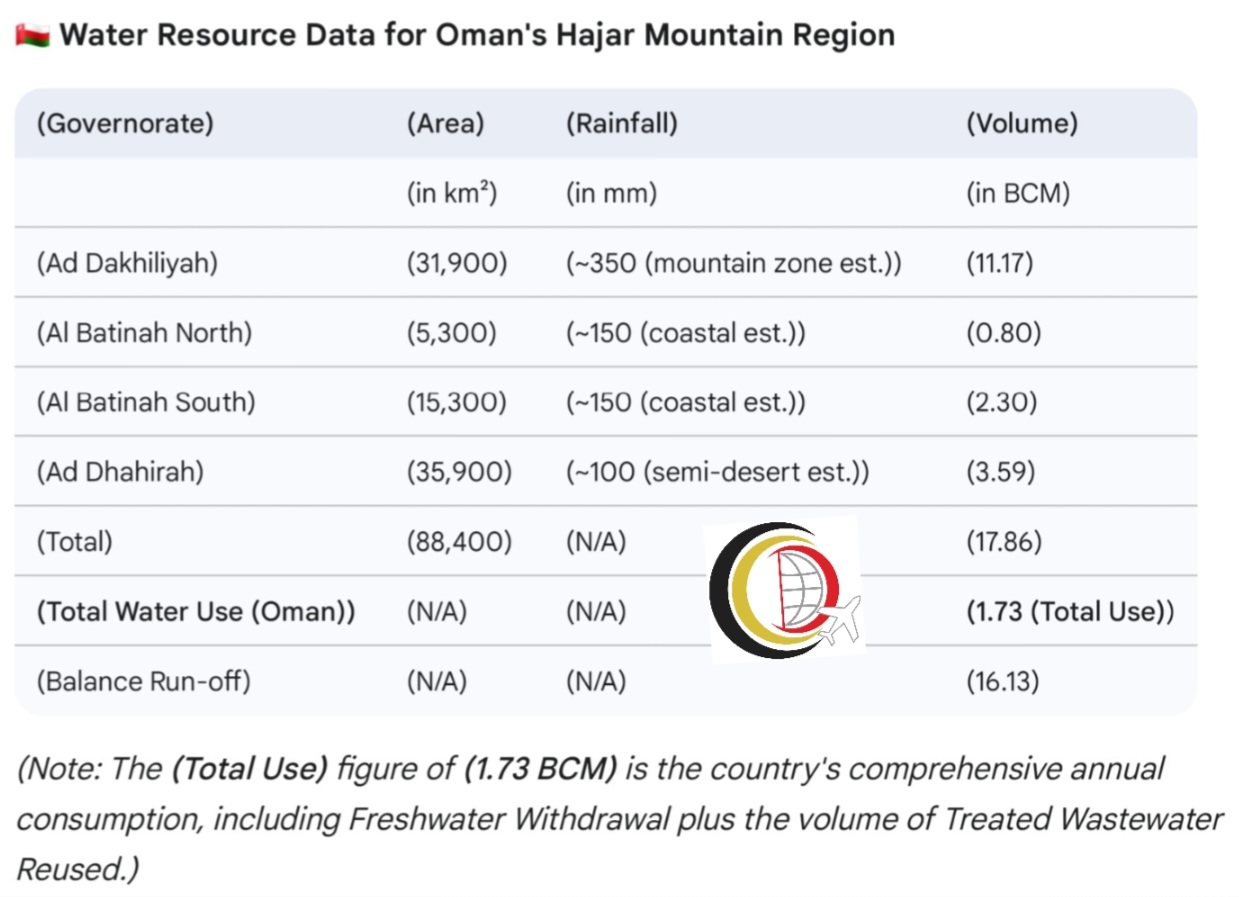
Oman
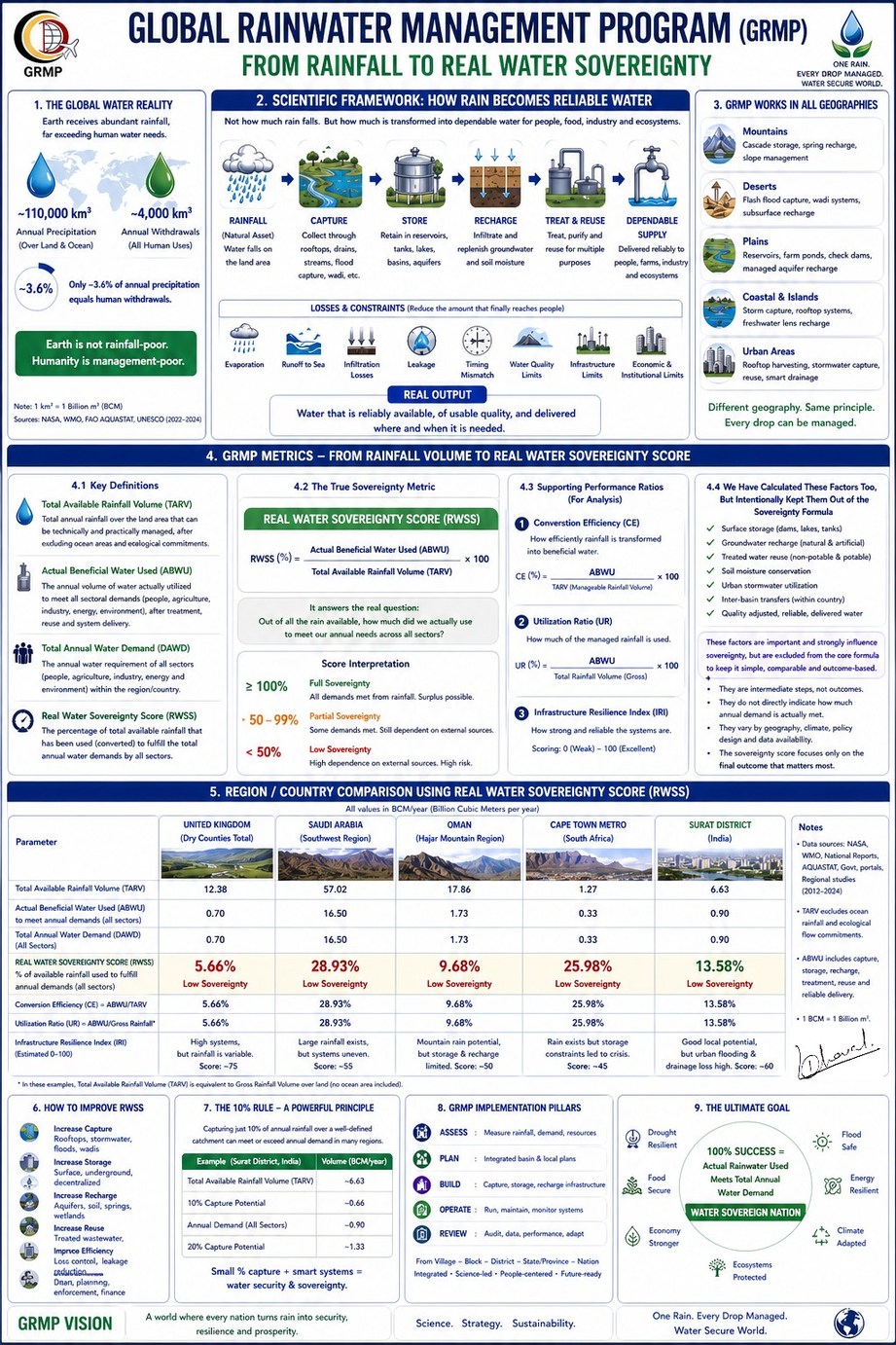
Illustrative values previously reviewed for selected Hajar mountain regions suggested rainfall volume around 17.86 BCM, compared with national annual use near 1.73 BCM.
Even partial capture or recharge of available rainfall could materially strengthen demand coverage.
Strategic lesson: lower-rain countries may still hold high opportunity if systems improve.
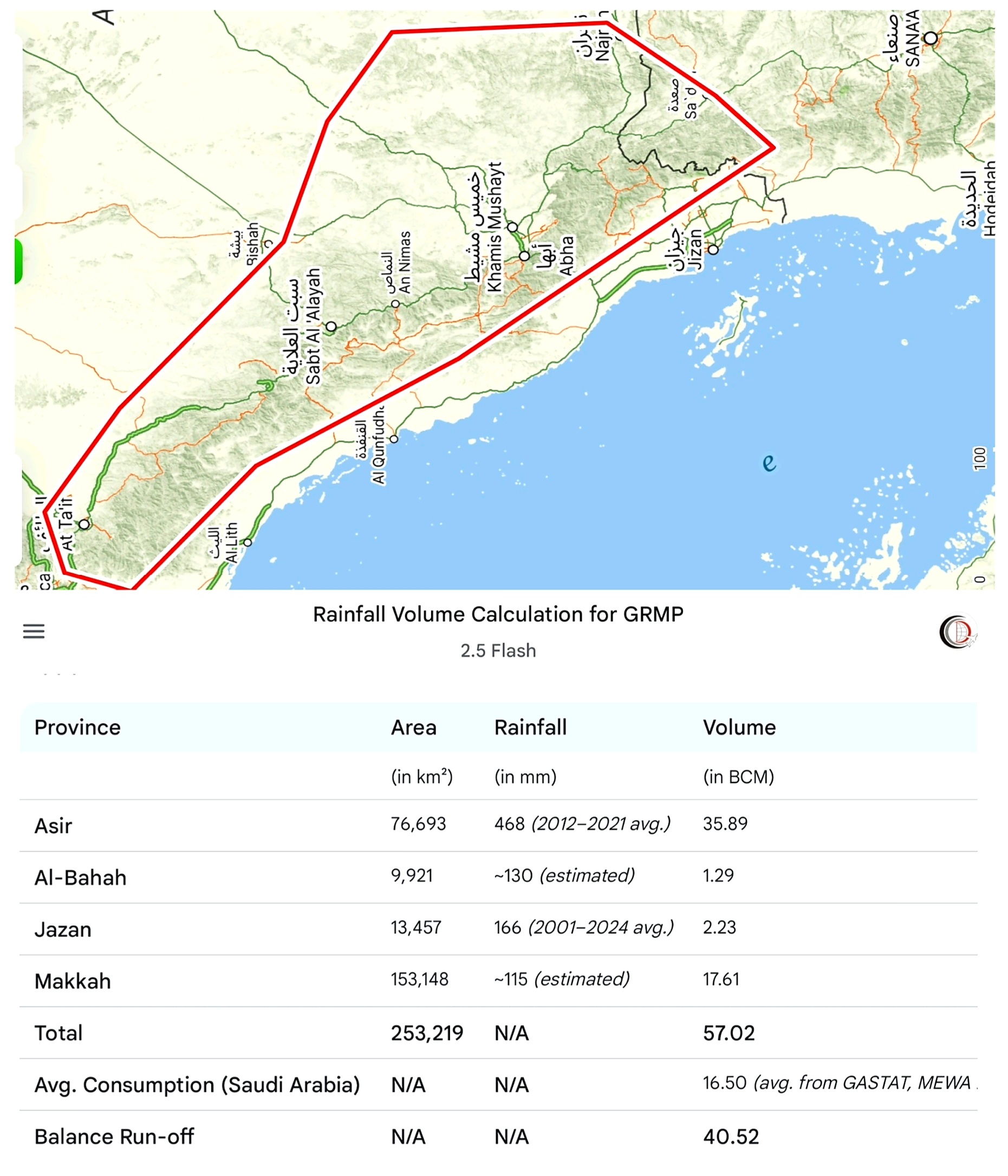
Saudi Arabia (Southwest Belt Example)
Illustrative regional rainfall values near 57 BCM compared with consumption around 16.5 BCM indicate that rainfall assets, while geographically uneven, may significantly offset demand if strategically harvested, stored, transferred, and integrated with reuse systems.
Strategic lesson: scarcity may also be a geography-distribution and management challenge.
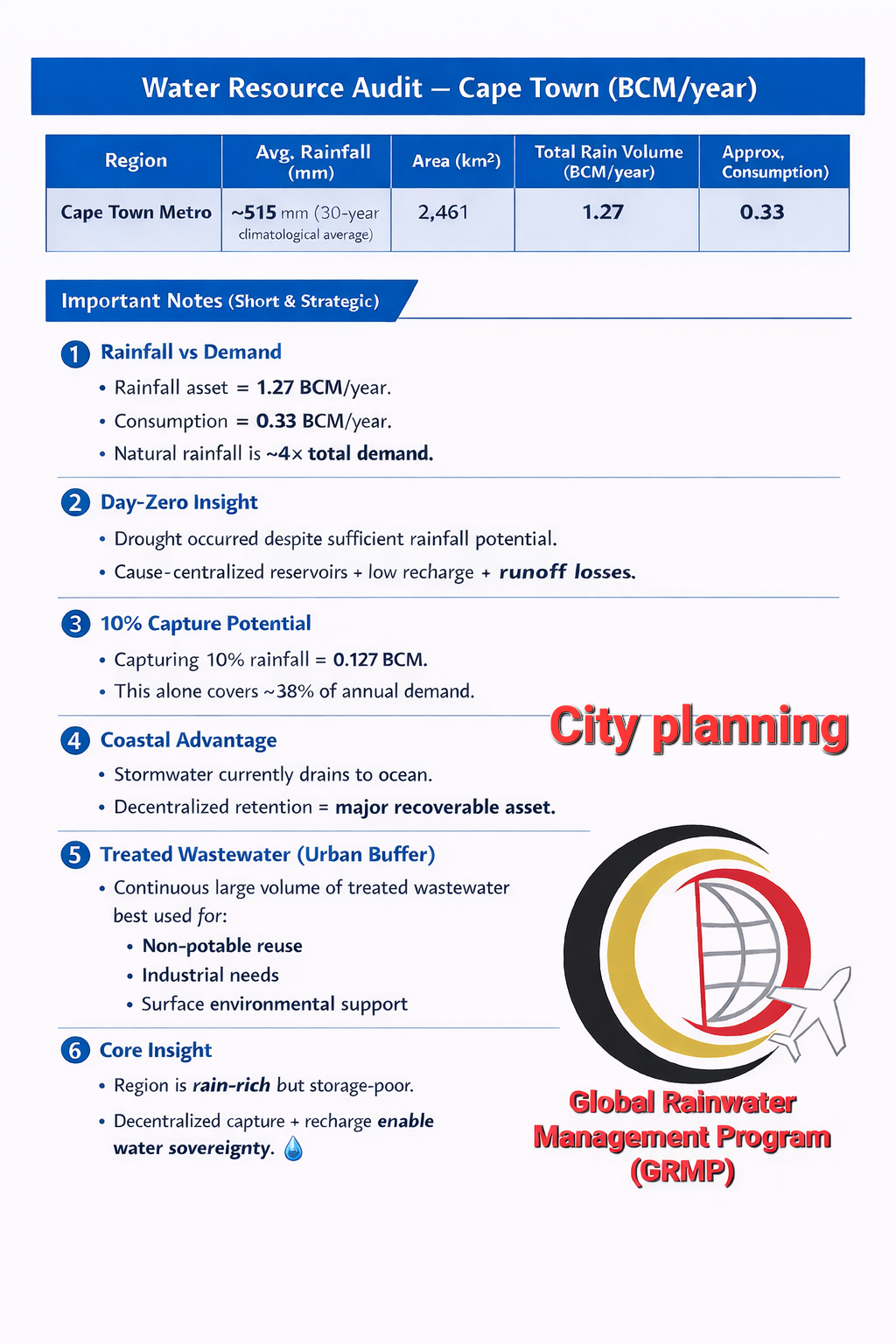
Cape Town
Illustrative values of around 1.27 BCM rainfall versus demand near 0.33 BCM show that crisis can occur even where rainfall exists.
Strategic lesson: storage resilience, drought sequencing, and governance readiness matter.
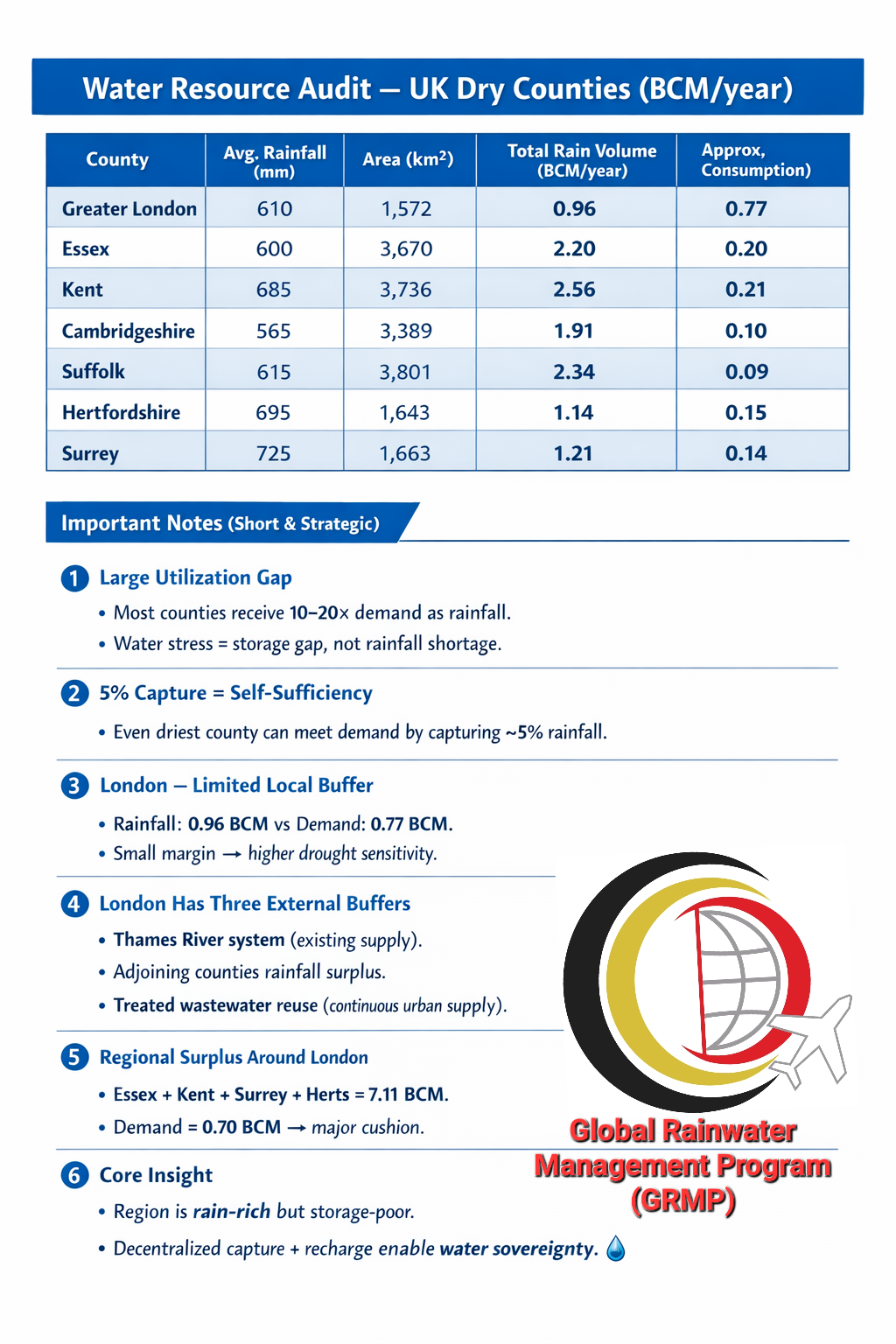
East UK / Dry Counties Example
Some regions receive rainfall volumes greater than direct annual demand, yet still experience stress due to leakage, storage constraints, infrastructure aging, or planning limitations.
Strategic lesson: stress can be infrastructure-driven, not rainfall-driven.
Global Perspective
According to FAO AQUASTAT, nearly 110,000 km³ of precipitation falls on land annually. Global freshwater withdrawals are estimated around 4,000–4,600 km³/year depending on source year and methodology.
Approximately:
This means annual human withdrawals are only a small fraction of total land precipitation.
This does not mean all rainfall is usable. Rainfall is unevenly distributed across seasons and geography. Ecological flows must be preserved. Large shares remain inaccessible or uneconomic to manage.
However, the figures do indicate that global water discussion should include not only scarcity, but also:
- storage capacity
- conversion efficiency
- reuse systems
- governance quality
- resilience planning
In simple terms:
Earth is not uniformly rainfall-poor. Many human systems remain water-asset underperforming.
Why GWSI Strengthens Existing Global Reports
GWSI does not oppose drought or water crisis reporting.
It complements it.
Traditional metrics measure:
- stress
- depletion
- vulnerability
- crisis exposure
GWSI adds measurement of:
- unrealized rainfall assets
- circular water opportunity
- renewable demand coverage
- governance performance
- sovereignty capacity
Traditional reports warn the world.
GWSI helps organize solutions.
Policy and Finance Relevance
What gets measured gets financed.
If countries measure only shortages, investment may flow mainly into emergency supply responses.
If countries also measure assets, they are more likely to invest in:
- harvesting systems
- aquifer recharge
- wastewater reuse
- decentralized storage
- watershed restoration
- smart metering
- leakage reduction
- local resilience systems
Therefore, GWSI can function not only as a scientific metric, but also as a strategic investment signal.
Recommended National Dashboard
Every country could publish annually:
- Total land rainfall volume
- Manageable rainfall estimate
- Rainfall captured (%)
- Stormwater recovered (%)
- Wastewater reused (%)
- Recharge added (BCM)
- Demand met from renewable managed assets (%)
- GWSI score
Conclusion
The future of water governance should measure both sides of the balance sheet.
Liabilities
- drought risk
- scarcity
- depletion
- demand stress
Assets
- rainfall
- recharge potential
- recoverable runoff
- wastewater reuse
- conversion efficiency
- sovereignty capacity
The Global Water Sovereignty Index (GWSI) is proposed as a practical Water Assets Index that can expand, strengthen, and modernize the scope of current global water crisis and bankruptcy narratives.
Water risk metrics remain essential.
Water asset metrics are now equally necessary.
Success is not only how much rain falls.
Success is how much demand water assets can sustainably meet.
Critics vs Propagators: A Practical Debate on Water Sovereignty
Any new water governance framework should be tested against real-world criticism. The discussion around Global Water Sovereignty Index (GWSI) and Globl Rainater Manaement Proram (GRMP) is no exception. Below is a constructive comparison between current critical viewpoints and the responses offered by those advocating a stronger water-assets approach.
The purpose of this section is not confrontation. It is to clarify where the real technical and policy differences lie.
Special Attention: Investment Gap in Global Water Governance
Critics
Traditional global water reports already identify scarcity, drought risk, infrastructure deficits, and SDG financing gaps. Additional indices may create duplication without materially increasing investment flows.
Propagators
Current reports provide an essential warning function, but many are primarily risk-oriented. They successfully describe the scale of the crisis, yet investors, sovereign funds, development banks, and private capital often require more than risk signals. They also look for measurable opportunity, performance indicators, asset pipelines, and credible return pathways.
This is where GWSI can add value.
By measuring rainfall assets, recharge potential, wastewater reuse, demand coverage, and sovereignty gains, GWSI can help translate water resilience into investable logic.
Examples include:
- avoided emergency supply costs
- reduced flood damage losses
- lower dependence on expensive substitute sources
- improved agricultural reliability
- stronger industrial water security
- measurable infrastructure performance gains
In this sense, traditional reports often diagnose the financing gap, while GWSI can help frame practical pathways to close it.
The purpose is not to replace existing reports, but to convert awareness into bankable action.
1. Urban Runoff and Recharge Safety
Critics
Urban rainwater can contain sediments, oils, heavy metals, pathogens, and waste residues. Recharging such water into aquifers may create long-term contamination risks that are difficult to monitor and expensive to reverse.
Propagators
This concern is valid if recharge is unmanaged. GRMP does not advocate raw or uncontrolled injection. It promotes pre-treatment systems such as first-flush diversion, sediment removal, layered filtration, biological polishing where suitable, water-quality testing, and aquifer suitability assessments before recharge occurs.
Under this approach, recharge becomes a managed environmental engineering activity rather than a disposal practice.
2. Rainfall Is Seasonal and Unreliable
Critics
Rain falls irregularly. Many regions experience a few intense events followed by long dry periods. Seasonal rainfall cannot be treated as dependable annual supply.
Propagators
Seasonality is real, but it is a storage and planning challenge rather than an argument against management. GRMP responds through diversified storage systems including tanks, reservoirs, retention basins, managed aquifers, and treated wastewater reuse that extends supply beyond rainy periods.
The objective is not to consume rain only when it falls, but to convert episodic rainfall into year-round resilience.
3. Dense Cities Cannot Capture Enough Rainfall
Critics
Modern cities lack open land for lakes, reservoirs, or new water infrastructure. Dense urban form makes large-scale rainwater capture unrealistic.
Propagators
GRMP views cities differently. Dense cities already possess extensive infrastructure assets: rooftops, roads, drains, parking zones, parks, utility corridors, and underground spaces. These surfaces can be redesigned into distributed capture, detention, infiltration, and reuse systems.
Urbanization can therefore become a water asset if intelligently retrofitted.
4. Decentralized Systems Fail Due to Maintenance
Critics
Small distributed systems often degrade over time. Filters clog, drains fail, monitoring weakens, and maintenance responsibility becomes unclear.
Propagators
This is a legitimate governance concern. GRMP therefore emphasizes passive, low-maintenance, and maintenance-light designs using gravity flow, modular components, durable materials, self-cleaning layouts, accessible inspection points, and simple operating procedures.
Where technology is used, digital monitoring and performance-linked maintenance contracts can improve reliability. The goal is resilient decentralization, not unmanaged decentralization.
5. Dry Countries Simply Do Not Have Enough Rain
Critics
Arid and semi-arid countries cannot realistically solve water insecurity through rainfall because natural precipitation is too low.
Propagators
Some countries do face severe hydrological limits, and GRMP recognizes that rainfall alone may never meet full demand in every case.
However, national averages often hide important regional realities. Many countries categorized as dry still receive meaningful rainfall in mountain zones, coastal belts, storm corridors, wadis, or short-duration seasonal events.
Examples previously discussed include Saudi Arabia and Oman, where selected regions receive rainfall volumes that may materially support annual demand if effectively captured, stored, recharged, or integrated with reuse systems.
The argument is not that every dry country can rely on rainfall alone. It is that many can improve sovereignty substantially by maximizing available rainfall assets first.
6. Desalination Is Simpler and More Reliable
Critics
Why pursue complex rainwater systems when desalination can provide predictable large-scale supply?
Propagators
Desalination can be strategic and valuable, especially in coastal arid regions. However, it often requires high energy input, major capital cost, long-term operating expenditure, and concentrated coastal infrastructure.
GRMP does not reject desalination. It argues that lower-energy domestic renewable assets should also be maximized so that desalination becomes one tool among many, rather than the only pillar of security.
7. Water Crises Are Mainly Climate Problems
Critics
Drought, heat, and changing rainfall patterns are climate-driven problems. Management reforms alone cannot solve them.
Propagators
Climate risk is real and increasingly severe. Yet outcomes are also shaped by infrastructure quality, storage capacity, leakage losses, reuse rates, land planning, and governance effectiveness.
Two regions facing similar rainfall stress can experience very different outcomes depending on management quality. Climate and governance must therefore be assessed together.
What This Debate Really Shows
The deeper policy debate is rarely rainfall versus no rainfall. It is more often:
- reactive crisis response versus preventive resilience
- liabilities-only metrics versus assets-plus-liabilities metrics
- centralized dependence versus distributed buffering capacity
- short-term supply fixes versus long-term sovereignty planning
Final Reflection
Strong frameworks do not avoid criticism. They improve through it.
That is why GWSI and GRMP should be openly debated, locally tested, transparently measured, and continuously refined.
Invitation for Discussion
Could future global water reports include a standardized Water Sovereignty / Water Assets Index alongside existing scarcity and drought indicators?
.
Dhaval Pandya
Chairperson: Global Rainwater Management Program (GRMP) Framework.
.
Manalika Pandya
Managing Trustee & Researcher.
Shree Someshwar Education Trust, Surat, India.