Kumbharwadi, a rainfed village faced acute land degradation, water scarcity, low farm agricultural productivity, and migration. Through the Indo-German Watershed Development Programme (IGWDP), the Watershed Organisation Trust (WOTR) initiated watershed development, driven by community participation and ownership via Village Watershed Committees (VDC’s). Interventions reduced soil erosion by 62%, improved groundwater recharge and irrigation facility, promoted crop diversification, and livestock based livelihoods, strengthening incomes and reducing migration. The socio-scientific approach has resulted in a Benefit-Cost Ratio of 2.3 after 25 years of implementation.
Background
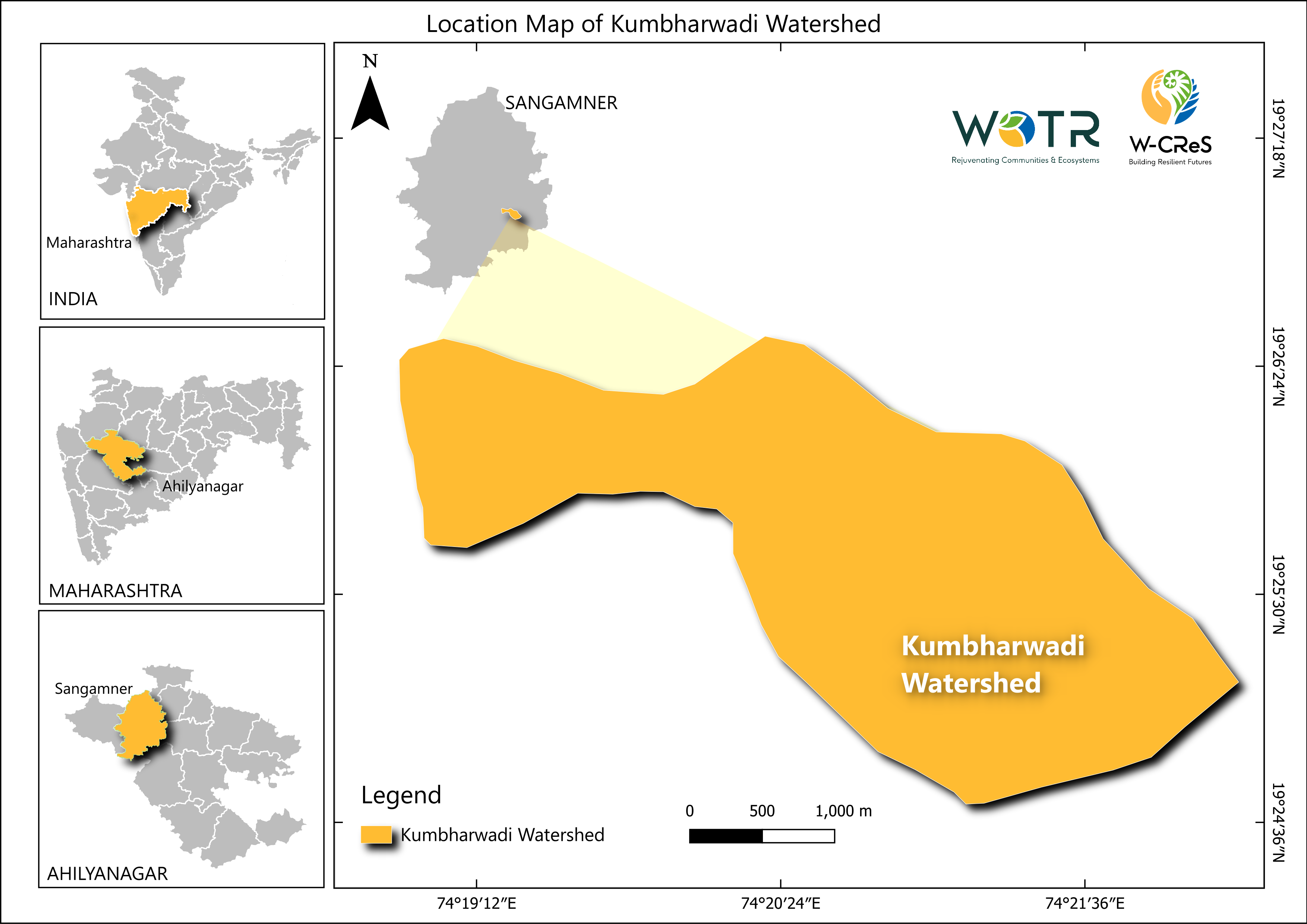
Kumbharwadi watershed lies in the rain-shadow region of Maharashtra, India. The Kumbharwadi village primarily consists of hill slopes and valley land. Jondalwadi and Ugalewasti are the two hamlets within the Kumbharwadi watershed, located on the ridge and in the valley respectively. The watershed covers a total area covered by the watershed is 910 hectares having 180 households. Before the Watershed Development (WSD) project, the community faced complex set of socio-hydrological and economic challenges: 50 percent of the land was rendered unproductive, overgrazing of commons was rampant, water conservation measures were minimal, and seasonal migration was widespread.
The region receives an average annual rainfall of 476 mm, often marked by erratic distribution and frequent droughts. Water scarcity was a paramount issue in the village. In drought years, women and girls spent several hours fetching water for household needs, which affected both education and income earning opportunities. The village, relied on government water tankers to meet their drinking water demands during the summer months prior to the WSD. Global climate change has intensified the problem: in the past 7 years, the village has received only 25 annual rainy days throughout the monsoon season, while the year of 2018 an officially declared drought year, saw just only 10 rainy days with a total of 118 mm of rainfall.
Limited availability of surface and groundwater had severe impacts on agricultural practices. The community was primarily engaged in subsistence farming, cultivating for only 6-7 months annually, mainly during the monsoon season. Traditional agricultural practices dominated leading to only two major crops cultivated, pearl millet as the principal crop in the monsoon and sorghum by a handful of farmers in winter. Small and marginal farmers were the most severely affected due to lack of irrigation facilities to cultivate more than the monsoon crop, triggering distress migration. Some of these migratory laborers worked as sugarcane cutters in distant districts, in abysmal conditions. Improper housing facilities, poor water quality, financial exploitation, poor access to hygiene facilities, all of this leading to frequent health issues.
The socio-economic problem was further aggravated by environmental fragility of the region. High soil run-of, degraded lands and reduced vegetation cover led to severe loss of biodiversity. Weak local governance further undermined the resilience. Poverty led to ineffective community management, poor leadership, weak institutions and poor stewardship of commons. These multifaceted crisis in Kumbharwadi village, called for a participatory integrated approach not only to restore degraded lands and improve water availability but also to strengthen community institutions for equitable management of natural resources.
Actions taken
The Indo-German Watershed Development Programme (IGWDP) funded by the Government of Germany (BMZ) was implemented by Watershed Organisation Trust (WOTR) using Ridge to Valley approach which involves treating land and water resources from the ridge down to the valley to control soil and water run-off.
Rationale for Intervention
Villages in the rain shadow district of Ahilyanagar (formerly Ahmednagar) faced regular water scarcity, low agricultural productivity and high socio-economic vulnerabilities, especially during years of drought or poor rainfall. The WSD initiative in Kumbharwadi was therefore designed as a participatory framework aimed at ecological restoration of land and water resources, while keeping community at the center of planning and implementation.
Primary objectives
The Primary objectives of this WSD program were to:
- Reduce land degradation, promote reforestation, and restore landscapes.
- Harvest rainwater in situ, in natural aquifers; increase water availability.
- Improve land productivity.
- Empower local communities including women, through inclusive Village Watershed Committees (VWCs) and Self-Help Groups (SHGs).
- Capacity development of local communities for governance, active participation, benefit sharing and management of the watershed resources, for long-term sustenance.
These objectives were defined by WOTR and the National Bank for Agriculture and Rural Development (NABARD), India, both who were official partners in the IGWDP. The implementation involved NGOs, VWC, and Panlot Sevak (WSD workers) who were capacitated with technical, social and institutional guidance for participatory WSD.
Phased Implementation
WSD in Kumbharwadi, was carried out in two phases between 1998 and 2002. To qualify, the village first had to demonstrate commitment by signing an agreement to ban tree cutting and free grazing, and by contributing 16% soil and water conservation (SWC) costs as shramdan (own contribution). As an early act of collective action, villagers widened the footpath over the hill into a rough road enabling WOTR’s team to access the village.
Capacity Building
During the first 18 months, villagers underwent hands-on training in SWC measures on 80 ha of land. The VWC was formed with women and men village representatives and became the core implementing body, entrusted with planning, implementation, payment for work and record keeping, under guidance of WOTR, It also ensured compliance with agreed restriction on grazing and tree cutting.
Participatory Net Planning (PNP)
For the Full Implementation Phase (FIP), WOTR and the community prepared a detailed feasibility report using PNP. The PNP integrated technical and environmental feasibility, with community feedback, and cost-benefit analysis helping identify the most suitable activities for maximum ecological and socio-economic payoffs.
Full Implementation Phase (FIP)
Following the successful CBP, the FIP was initiated with NABARD support which lasted till 2002. Guided by PNP, the VWC, Panlot Sevaks and villagers implemented wide range of SWC measures supported by WOTR’s technical team. The work was done partly as paid labour and partly as shramdan.
Across the 910 ha watershed, the interventions reduced soil erosion, increased infiltration and promoted afforestation via Area treatments like continuous contour trenches, water absorption trenches, stone bunds, farm bunds, and loose boulder structures were made, Drainage line treatments like gully plug, earthen nala bunds, gabion, and check dams were constructed. Farm bunds were created on 475 ha, while 375 ha of degraded forest and wasteland were treated with contour trenching, and tree plantation.
The VWC held regular meetings to report progress and managed finances. Maintenance fund was also established to support the upkeep of watershed structures.
Outcomes
The Watershed Development project in Kumbharwadi generated multi-faceted impacts between 1998 till 2024, ranging from ridge-level ecological improvements to valley-level economic and social transformations.
Ecological and Groundwater Level Outcomes
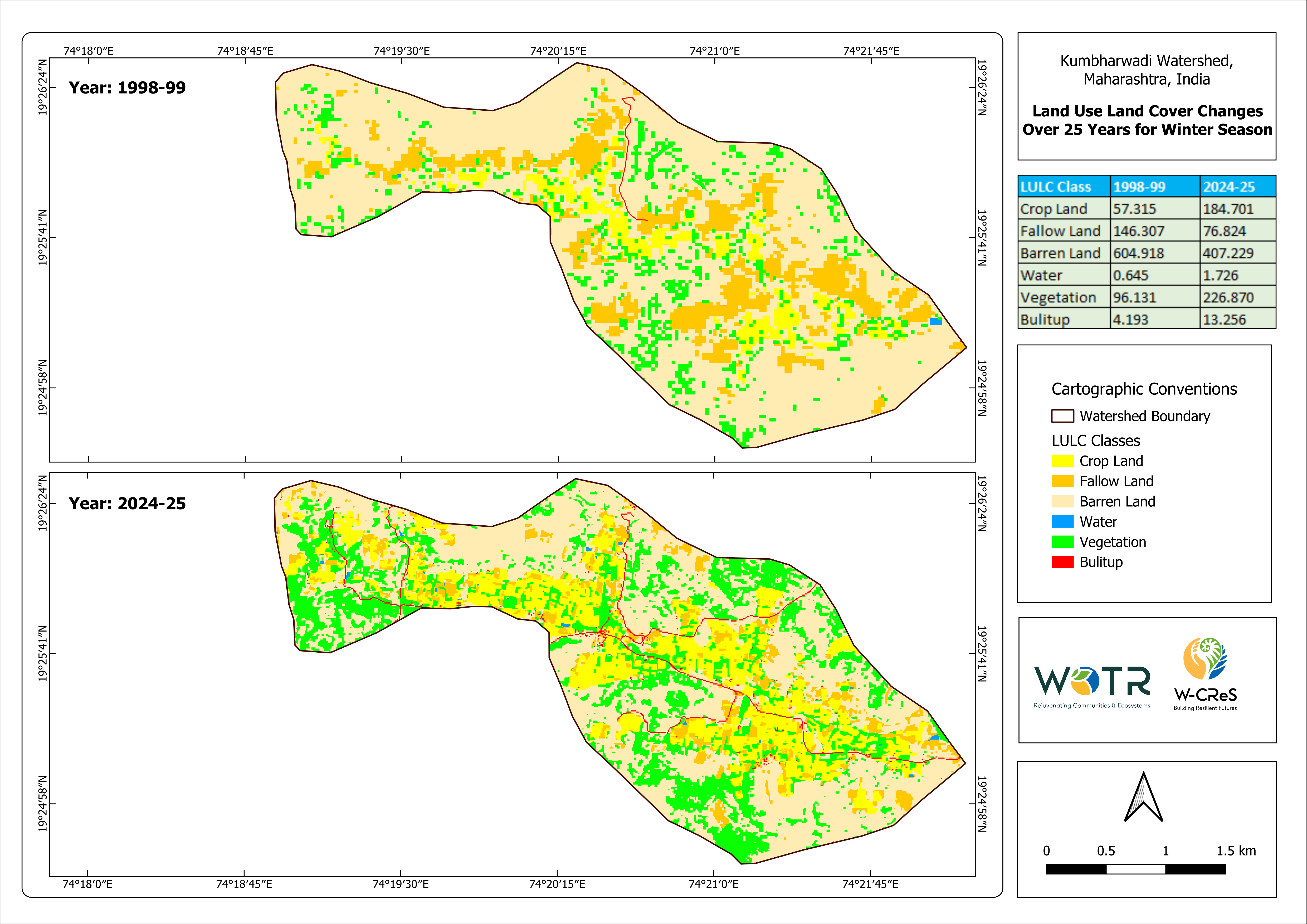
Soil erosion has reduced by 62% resulting in improved vegetation cover from 96 ha. in 1998 to 226 ha. in 2024. Groundwater level improved due curtailment of runoff and recharge of acquirers, from an average below ground level (bgl) of 7.6 m in 1998 to 6 m bgl in 2024.
Agricultural Outcomes
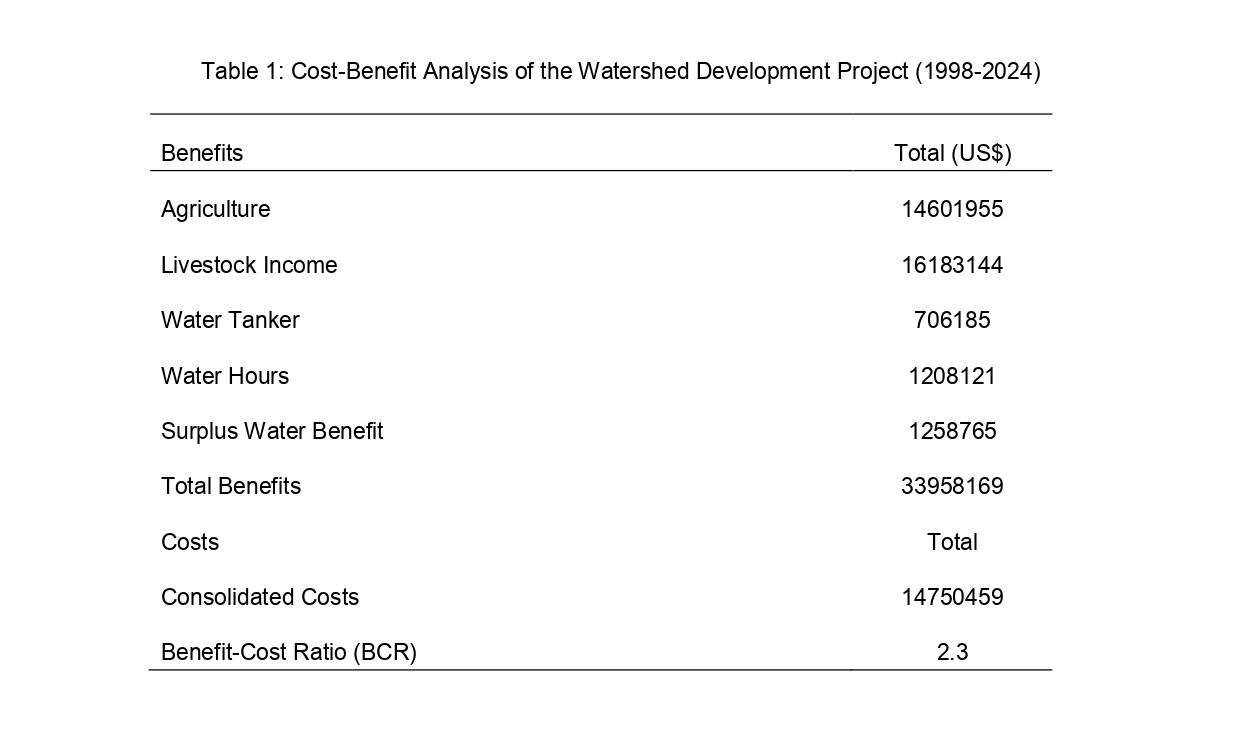
Improved water availability has increased in the total irrigated area under cultivation allowing farmers to cultivate in more than one season. Non-monsoon irrigation stood at 150 ha. in 2024 from just 82 ha. in 1998. Farmers shifted to cash crops like tomatoes and onions along with groundnut, green gram, and chickpea. There has been shift to natural farming and promotion of micro-irrigation and sprinklers for irrigation. These practices have lowered costs of cultivation while increasing yields. Agricultural income has risen from US$ 69,000 in 1998 to US$ 549,873 in 2024.
Livestock Outcomes
Livestock, is now a major livelihood source for the community, with income rising from $42,000 in 1998 to $1.13 million in 2024. The village now has 3 milk collection centers, connected to nearby dairies; the community also engages in selling of small ruminants and poultry, making this sector a key source of income for households.
Social Outcome
Improvement in the domestic water availability, reduced dependency on water tankers leading to an estimated saving of US$ 706,185 over 20 years. The time saved from fetching water has preserved labour hours equivalent to US $1.2 million.
Resilience to Climate Variability
During the drought year of 2018, the community experienced shortage of water leading to drop in vegetation cover to 151 ha. The agricultural area for the winter crop was affected with only 19 hectares cultivated, bringing down the total agricultural income for the year to US $378,806. Despite these challenges, the community was able to maintain its livelihood due to continued income from livestock.
Policy and Institutional Impact
Joint advocacy by WOTR and NABARD led to a creation of the Watershed Development Fund (WDF) by the Government of India in 1999. WOTR was responsible for Capacity Building of NGOs, NABARD staff and others. As of 2024, WDF has since restored 2.7 million ha. of land across India with a total outlay of US$ 344 million.
The WSD projects implemented by WOTR and IGWDP have contributed towards framing the Hariyali Guidelines in 2003, released by the Ministry of Rural Development, India. These guidelines decentralised the watershed development by empowering the village councils to plan and execute projects. WOTR’s ecosystem based sustainable land management approach has recently been adopted by the Maharashtra State Action Plan on Climate Change.
Sustainability of Intervention
After 25 years, Kumbharwadi continues to maintain watershed structures through the VWC in collaboration with the Forest Department. Fewer rainy days, rising temperature, and in pursuit of expanding cultivation, individual interests sometimes outweighs collective agreements. These challenges are being dealt with continued capacity development process along with WOTR’s Water Stewardship tool for demand side management which is promoting water equity. These efforts have led to a benefit-cost ratio (BCR) from 1998-2024 as 2.3.
Wider Replication
Community mobilization a challenge experienced during the initial implementation, was addressed in a phased manner through various community events, and through SHGs. Today, the educated younger generation in the village is being brought into action. Using scientific assessments and tools that demonstrate the ecological and economic benefits of land and water management in a climate context, will continue to incentivize other villages to protect their natural resource base.
Lessons Learned
Community Ownership and Capacity Building for Scalability
Inclusive participation, knowledge sharing and equitable benefit distribution ensures long term sustainability. The success of any development initiative requires adequate time and investment not only in building WSD structures but, for capacity building of the local community which as ensure scalability for replication.
Income Generation Drives Adoption
Restoration leads to higher incomes, resulting in adoption of sustainable practices. Farmers in Kumbharwadi opted for water use planning and low water intensive cash crops with nature friendly farming practices due to significant increase in income inspiring adoption in 380 villages.
Locale Specific Ecosystem Restoration
Ecosystem restoration tailored to suit local environmental and climatic conditions is key to sustained ecological health and economic benefits. Such policies can ensure its effective replication in different regions globally. WOTR through its past learnings from IGWDP has successfully implemented WSD in Malawi, Africa with the help of local NGOs.
Diversified and Phased Financing
Blending funding sources- grants, community contribution, bonds etc. strengthen financial sustainability. Phased financing of interventions starting with watershed restoration followed by agriculture and water management, ensures sustained support to build long term ecologic and economic resilience.
Post Project Support
Externalities such as climate change, market pulls, national and international policies affect the sustainability of SLM initiatives. Post project engagement through workshops, knowledge sharing mechanisms helps the communities respond effectively to emerging challenges.
